Finding Your Nebraska Public Water Provider and Local Utility
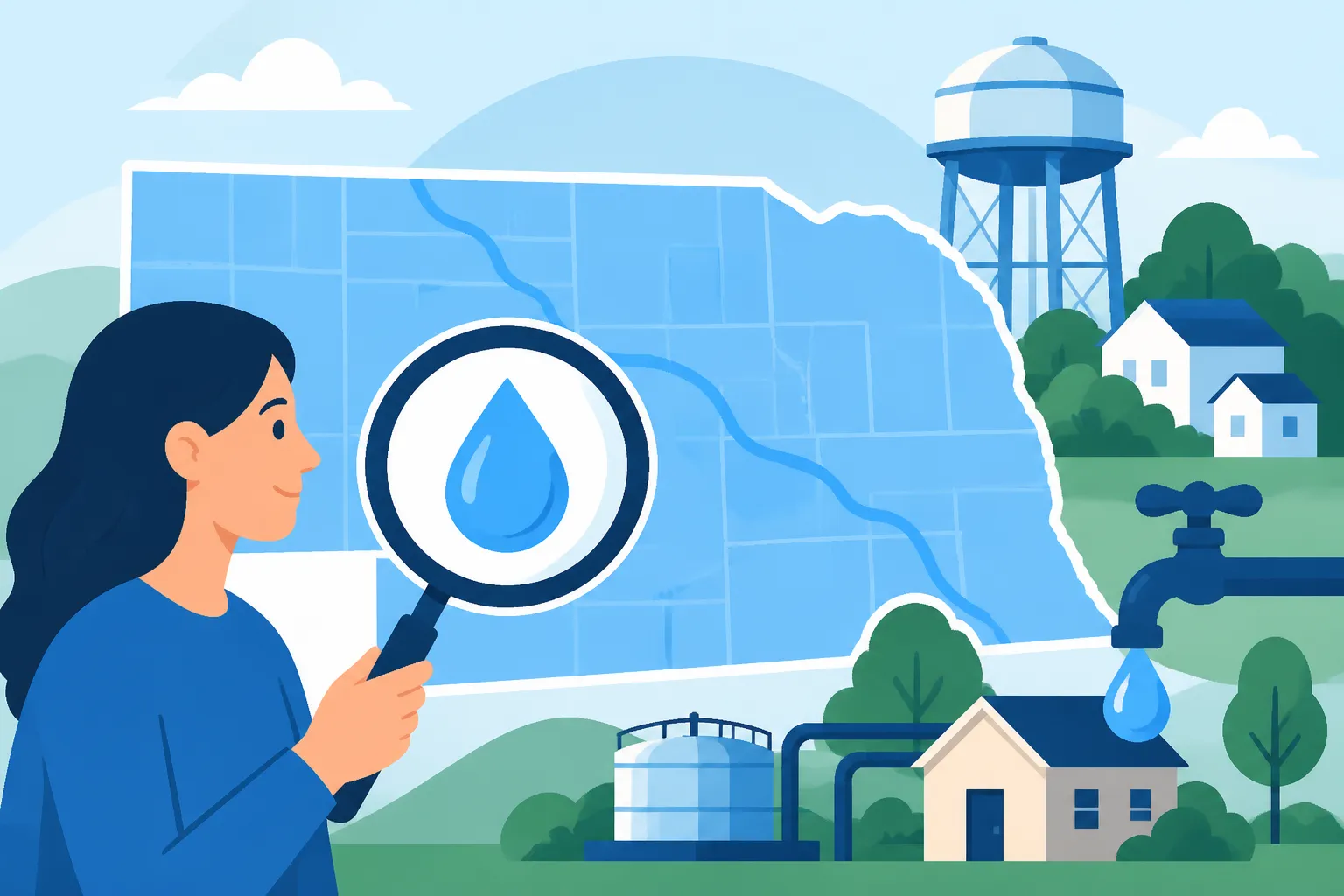
If you need to check a water notice, ask about a bill, or find out who maintains the pipes serving your home, first identify the provider for your exact address. Nebraska water service boundaries do not always match mailing addresses or city limits. Use address-specific records, billing information, and direct confirmation from the utility to establish who supplies your water.
Why finding the right provider can take more than a city-name search
A street address may have a city mailing address without being inside that city’s water service area. A property near a city boundary might receive water from a neighboring municipality, a rural public system, or a shared supply. In some areas, a property may instead rely on a private well. These arrangements are why searching for a utility by town name alone can lead to the wrong contact.
It also helps to separate a water provider from other organizations that may appear on a bill or property record. The organization that supplies drinking water may not be the one that handles sewer service, stormwater, garbage, or road maintenance. A landlord, property manager, homeowners association, or billing contractor may collect payments without operating the water system.
The provider matters because it is usually the best starting point for questions about:
- Current service interruptions or water-pressure problems
- Boil-water notices and other local advisories
- Water quality reports and routine monitoring
- Service-line material and work near the water meter
- New connections, account setup, and billing disputes
- A suspected leak on the public side of the service line
For broader background on how public systems operate, see Nebraska Public Drinking Water: Regulations, Systems, and Standards. If you already have a likely provider but want to check its reports and monitoring history, Nebraska Drinking Water Watch: Tracking Utility Test Records explains how state records can help.
A public water system is not necessarily a city department. It may be operated by a municipality, a rural or regional provider, a district, a cooperative, a private company, or another organization. The system may serve a community or a group of connections without having a name that matches the nearest town.
The reverse can also happen: one municipality may operate multiple water sources or service areas, while a single area may have different organizations responsible for water and wastewater. That does not mean the arrangement is unusual or incorrect. It means the service address, rather than the town name or property listing, should guide your search.
Start with the service address and the records you already have
Before searching online, gather the most precise address information available. Use the full street address, including a unit or apartment number where relevant. For a rural property, include the road name, house number if assigned, and the property’s county or parcel information if you have it.
Postal addresses can be useful for locating a property, but they are not always a reliable guide to utility boundaries. A mailing city is selected for delivery, not necessarily to show which municipality supplies water. The same caution applies to a real estate listing, map label, or tax record: those records can help locate the property but may not identify the water operator.
Check a water bill or account statement
A recent water bill is often the quickest clue. Look for the name of the billing organization, a service address, an account number, and a customer-service or payment portal reference. The organization named on the bill may be the provider, but confirm what role it plays if the arrangement is not clear.
For example, a bill could come from a city office that bills for both water and sewer, or from a third party that processes payments for another operator. If the bill shows separate water and sewer lines, check whether it names a different provider for each service. The entity collecting the payment and the entity responsible for treatment and water-quality notices are not always described in the same way.
If you do not recognize the organization on the bill, use the official website or the contact information printed on the statement to ask:
- Who operates the drinking water system serving this address?
- Does this organization own or operate the system, or only handle billing?
- Who issues water-quality reports and urgent notices?
- Which organization should be contacted about a leak or service interruption?
Do not assume a sewer charge identifies the water utility. A local government may bill for sewer service even when another provider supplies the water.
Ask the owner or property manager if you rent
Renters may not receive a water bill directly. The water account could be in the property owner’s name, included in rent, split among tenants, or passed through by a management company. Ask the owner or property manager for the name of the water supplier, whether the building has a separate meter, and where the latest water-quality report or service notice can be found.
A rental listing that says “city water” is a useful lead, not a complete answer. It may describe the general type of supply without identifying the operator. If you want to verify the building’s service-line information as well as the supplier, see How Apartment Renters Can Verify Building Service Line Material. For a summary of ways renters can obtain utility information, see How Nebraska Renters Can Obtain Utility Water Testing Summaries.
If the property uses a private well, there may be no public water provider to contact for the household’s supply. A landlord or property manager should be able to explain whether the unit is connected to a public system, a shared well, or an individual well. The distinction matters: a public utility’s annual water report does not represent water from a private well.
Use property and closing documents as clues
Home inspection reports, seller disclosures, account-transfer documents, and closing paperwork may name the provider or describe the supply as municipal, rural, shared, or private. These records are valuable starting points, especially when you have just moved in. However, they may be old or may use a general description rather than the current operator’s official name.
If a property changed hands, the former owner’s account information can also help identify the provider, but do not use an old account number or payment link without confirming it belongs to the current service address. Utility names, account arrangements, and online payment systems can change.
For a home purchase, confirm the provider before relying on a seller’s statement about water service. If you also need to know whether the property has a private well, this companion article may help: How to Tell if a Nebraska Rental Uses a Private Well or City Tap. For a rural property with both a well and public connection, ask whether one is active, abandoned, or used only for a particular purpose.
Search official records and mapping tools by address
Once you have a full address, use official sources to narrow down the likely provider. Start with the municipality or organization that appears on a bill or property record. Its official website may have a service-area map, a new-customer page, a water-billing portal, or a way to ask about a specific address.
If a city’s website does not make the service boundary clear, do not treat that as proof that the city does not serve the property. Some utilities provide address lookups only through customer service, while others use maps that are difficult to interpret near boundary lines. A map can show general coverage without resolving a particular parcel.
Check the state’s public water system records
Nebraska’s official drinking-water records can help you identify public systems and review information associated with them. Search using the system name if you know it, or use address, community, county, or nearby-system details to find likely matches. A record may include a system identification number, operator or contact details, and monitoring or compliance information.
State records are useful for confirming that a system exists and for learning its official name. They are not always an address-level service-boundary tool. A listing for a system associated with a nearby town does not, by itself, prove that a particular home is connected to that system. Treat database results as leads to verify with the provider.
For a step-by-step overview of searching state records, see How to Search Nebraska Drinking Water Watch by County. You can also read How to Confirm Which Nebraska Water Utility Services Your Property for more on verifying the match between a property and a supplier.
Use maps carefully
Online maps can make a search faster, but they vary in what they show. A map might mark a city boundary, a provider’s general service area, water mains, well locations, or a public system’s reported area. Those are not necessarily the same thing. A water main near a parcel does not prove that the property is connected to it, and a boundary overlay may not show private agreements or recent changes.
When a map suggests a likely provider, write down the provider’s name and any system identifier shown. Then confirm the address directly with the organization. If the online map has no address search, you can still use it to identify nearby providers, but avoid making a final decision based only on a visual estimate.
For a rural address, the nearest town is especially weak evidence. The property might be served by a rural public system whose name refers to a different community, or it may depend on a private well. Ask the property owner or provider directly, then check state public-system records if the answer suggests a public supply.
Check more than one source when the results conflict
When records disagree, compare the type and date of each record. A current utility account statement is strong evidence that an account exists at an address. A recent written response from the provider can clarify who operates the system. A state listing can confirm system identity and help you find monitoring information. An old real estate listing or general map label is less useful for confirming current service.
A practical way to resolve a mismatch is to ask the provider to confirm all three points:
- Whether it supplies drinking water to the exact service address
- Whether it operates the system or only bills for service
- Whether the address is connected to a public system, a shared supply, or a private well
If an organization says the address is outside its service area, ask whether it can identify the neighboring provider or the office responsible for boundary questions. It may not be able to speak for another system, but it can often explain why its records do not show the property.
Confirm the match directly with the likely utility
Direct confirmation is the most reliable way to settle an uncertain service address. Use the official website of the likely provider to find current contact details. If you have a bill, use the information on the statement and compare it with the organization’s official website before submitting personal or payment information.
When you contact the provider, give the full service address and explain what you need to confirm. A street name alone may not be enough, especially near a boundary, on a rural road, or in a subdivision with more than one supply arrangement. If the property has a unit number or a separate building, include that information too.
A focused request might ask:
- “Does your water system supply this service address?”
- “What is the system’s official name?”
- “Who operates it and sends water-quality notices?”
- “Is this address on public water, a shared system, or a private well?”
- “Where can I find the current water-quality report?”
- “Who handles a leak between the water main and the meter?”
- “Are there service interruptions or planned work affecting the address?”
The wording can be adjusted to your situation. If you need to identify a provider for a property purchase, ask for written confirmation if possible. If you need help with a current outage or notice, say that first so the issue can be directed appropriately.
Make sure you have the right department
A utility may divide responsibilities among billing, operations, water quality, engineering, and emergency response. You do not need to know the internal organization chart before calling. Explain the issue and ask to be directed to the right team. For water-quality reports or sample questions, request the staff responsible for drinking-water quality. For a leak or low pressure, ask for the current service or operations contact.
If the first person cannot confirm the boundary, ask whether the utility has an address lookup, service-area map, or account verification process. If you are told the address belongs to a different system, request the other system’s official name and confirm it independently. Avoid relying on an informal suggestion if the question affects an urgent safety notice or a planned water connection.
For questions about sampling, notices, and utility records, Contacting Your Local Water Provider About Sampling and Notices offers additional context. If you want to verify a notice from a message, social post, or neighbor, see How to Confirm Water Quality Notices Directly With Your Utility.
Keep a record of the answer
For a routine question, a note of the provider’s name and the date you confirmed it may be enough. For a home purchase, connection request, billing issue, or unresolved boundary dispute, keep the email or written response. Record the system name and the official website where you found its current contact details.
This is useful later if you need to locate a report, check whether a notice applies to your address, or explain a service history to a landlord or buyer. It also reduces the chance of confusing a water provider with a sewer department, billing contractor, or neighboring utility.
Understand public water, private wells, and shared arrangements
Not every Nebraska home receives water from a city utility. Some properties use a private well, a shared well, or another arrangement that serves a limited group of homes. A rural location does not automatically mean a private well, and a city mailing address does not automatically mean public water. Confirm the supply type rather than guessing from the property’s setting.
Public water systems
A public system can be operated by a city, village, district, rural provider, cooperative, private company, or another organization. The operator’s name may differ from the place name residents use in conversation. It may also appear under a formal system name in state records.
When you find a provider, check whether it has a current consumer water-quality report and a process for sending notices. Public systems generally publish or provide information about the water they deliver, but the exact report and monitoring history belong to the named system. Do not assume a report for a nearby community applies to your address unless the provider confirms that your home is served by that system.
For help understanding what an annual report can and cannot tell you, see Nebraska Consumer Confidence Reports: Reading Your Water Quality. If your concern is about the difference between system monitoring and water at a household tap, Does Your Annual Water Report Reflect Water at Your Tap? explains why plumbing and service lines can matter too.
Private wells
A private well is not a public utility account. The homeowner or property owner is generally responsible for arranging testing and maintenance, subject to applicable rules. A city water-quality report does not describe a private well simply because the well is near a city or within a postal area.
If the property uses a well, find out who owns and maintains it, whether it serves only one property or multiple users, and when it was last tested. A well may also exist on a property that is connected to public water, so ask whether it is active and what it supplies. Do not assume that a visible well or pump is the household’s current drinking-water source.
For more information on private supplies, see Guide to Owning a Private Drinking Water Well in Nebraska and Nebraska Private Well Water Testing: Annual Panels and Standards. If you are buying a rural property, Buying a Rural Nebraska Property: Complete Well and Septic Guide covers the broader questions that come with a well-and-septic arrangement.
Shared supplies and private subdivisions
Some homes receive water through a system shared by several properties or through a small public system that does not operate like a large city department. A homeowner may pay a property association, system manager, or another organization rather than a city utility. The organization that sends the bill may have a different name from the system shown in state records.
Ask who operates the supply, who is responsible for routine water testing, and how customers are notified when a problem occurs. If the provider is a private association or shared-system manager, ask for the current operating contact and any documents describing responsibilities. For a public system, state records may help identify the official system name, but direct confirmation is still useful.
The distinction can affect where to ask about repairs, sampling, and records. It can also matter when a property changes ownership. A seller’s statement that a home is “on community water” does not identify who manages the system or what obligations transfer to a buyer.
Water and wastewater may have different providers
A property’s drinking water and sewer service can come from separate organizations. For instance, a regional provider might supply water while a municipality bills for wastewater, or a home may have public water but an individual septic system. A single bill can also combine charges from more than one service.
Check each line item rather than assuming the name at the top of a bill handles everything. If your issue is sewage backup, wastewater billing, or a septic system, the water utility may not be the right contact. If the problem concerns drinking-water quality, the sewer provider may not have the relevant records.
This distinction is particularly helpful when moving into a home, reporting a problem, or trying to locate the correct bill-payment site. Ask separately who supplies drinking water, who handles wastewater, and who maintains any private well or septic equipment.
Find the right contact for common water questions
Once you know the provider, match your question to the right information source. The provider’s official website is a good first stop for current service notices, account information, water-quality reports, and contact options. State records are useful for system-level monitoring or compliance information. A household test, when appropriate, answers a different question from a system report.
| What you need to know | Best starting point | What to confirm |
|---|---|---|
| Whether a provider serves your address | Provider’s official website or customer service | Exact service address and system name |
| A current outage or low-pressure problem | Utility’s official service or emergency notice channel | Whether the issue affects your street or account |
| A boil-water or other safety notice | Utility’s official notice page or direct contact | Whether the notice applies to your address and what instructions are current |
| Annual water-quality information | Provider’s consumer report and state records | Whether your address is served by the system named in the report |
| A billing or account question | Organization named on the current bill | Whether it supplies water or only processes payment |
| A private-well question | Well owner, property manager, and qualified testing resources | Who maintains the well and what testing has been done |
| A leak or service-line question | Provider and, when needed, a qualified plumbing professional | Which portion of the line is the utility’s responsibility |
Water-quality reports and monitoring records
A provider’s annual report is useful for understanding the system’s reported source water, monitoring, and results. It is not a substitute for confirming that the address belongs to the system named on the report. If a renter receives a link from a landlord, check the system name and service area before relying on it.
State databases can add useful detail, but they may present records by system rather than individual household. A monitoring entry does not necessarily describe the water from a specific kitchen faucet. Household plumbing, fixtures, and service-line materials can affect water after it leaves the public system.
If you are trying to understand a test result, identify whether it came from a utility sample or a sample collected at your home. The sampling location, method, and contaminant requested all affect what the result can tell you. For a comparison of these data types, see Utility Compliance Testing vs. What Comes Out of Your Faucet and Evaluating Nebraska Tap Water Quality: Reports and Lab Data.
Notices and service interruptions
For a current boil-water advisory, pressure loss, main repair, or other service issue, use the provider’s official notice channel. Social media posts and neighborhood messages can be useful prompts to check, but they may omit the affected area or remain visible after the situation has changed. Confirm the notice with the utility before deciding whether it applies to your address.
If a notice does apply, follow the instructions from the issuing utility or public health authority. The steps can depend on what happened and the affected area. Do not rely on a generic notice found online when the provider has issued address-specific or incident-specific directions.
For more on locating current notices in the state, see How to Check Current Boil-Water Advisories at Your Nebraska Home. If you want practical advice about following a notice at home, Using Water Safely During a City Boil Advisory: Cooking and Teeth covers common household uses.
Sampling and household concerns
If your concern is water at a particular tap, start by explaining the issue to the provider and ask whether it recommends sampling or can share relevant monitoring information. A utility may be able to explain its routine testing and system results, but it may not test every home’s plumbing. A household sample may be appropriate for some questions, but the sample needs to be collected and analyzed for the specific contaminant of concern.
A taste, odor, or appearance change can have different causes. The provider can tell you about system-wide work or known conditions, while a plumber may be able to assess a fixture or household plumbing problem. If health effects are a concern, ask a medical professional or your local health department rather than relying on taste or appearance to judge safety.
For a lead concern, provider monitoring and a household tap sample are not interchangeable. The utility can explain service-line records and any available program, while a properly collected tap sample can address water from a particular outlet. See How Older Plumbing and Service Lines Add Lead to Tap Water for background on why the household plumbing path matters.
What to do when you cannot identify the provider
If the bill, maps, landlord, and online records do not point to the same organization, use a simple sequence rather than guessing. Start with the exact service address. Ask the most likely provider to verify it. If that provider says it does not serve the property, ask whether it can identify the appropriate system or the official contact responsible for boundary questions.
For a property without a water bill, ask the owner or property manager to identify the supply type and provider. If the owner says the home uses a well, request clarification about whether it is private or shared and who is responsible for maintenance and testing. If the answer is that the home uses public water, ask for the system’s formal name and the provider’s official contact page.
For a new home purchase, check the details before closing if possible. Ask the seller, agent, or property manager for recent water bills and any account-transfer information. Confirm the provider directly rather than relying only on a listing or informal description. If the property has more than one source, ask which source supplies drinking water and whether any unused source remains connected to plumbing.
When a utility boundary is disputed, keep the response and ask what records the provider used to make its determination. There may be separate records for service territory, water-main location, and active customer accounts. A provider may need time to check internal maps or account records. If two organizations give conflicting answers, request written clarification from each and provide the full address, parcel information, and any relevant bill or closing document.
If the issue involves a current safety notice or water interruption, do not wait for a lengthy boundary investigation. Contact the likely provider using its official website and clearly describe the immediate problem. If the provider confirms it is not responsible, ask it to direct you to the correct public system or appropriate local authority. For questions about health effects, contact a medical professional or local health department.
Once you identify the provider, save the official website and note the system name. That small step makes it easier to find future notices and reports without repeating the search. It is also useful to keep the provider’s information with other household records, especially if you rent, manage a property, or expect to move.
Frequently Asked Questions
Does a Nebraska mailing address tell me which utility supplies my water?
Not reliably. A mailing city is used for postal delivery and may not match a water service boundary. Confirm the exact service address with the likely provider.
Can one organization bill me while another supplies the water?
Yes. A city, billing contractor, landlord, or property manager may collect charges without operating the drinking-water system. Ask who operates the system and who handles water-quality notices.
Does a nearby city’s water-quality report apply to my home?
Only if the provider confirms that your address receives water from the system named in that report. Proximity alone does not establish a connection.
How can I tell whether a rural Nebraska home uses public water or a private well?
Ask the owner or property manager, check any recent water bill, and confirm with the likely provider. If the property uses a well, clarify whether it is private or shared and who maintains it.
Who should I contact about a current water notice?
Check the official website or notice channel of the provider serving your address. Confirm that the notice applies to your location and follow the instructions issued for that specific event.
Disclaimer
This article is for general informational purposes only and does not constitute professional advice. Laws, prices and regulations vary by location and change over time. Consult a qualified professional for guidance on your specific situation. Nebraska Water Guide is not a government agency or water utility and is not affiliated with any public water system.